Blog
How to Fish a Deep Diving Crankbait?


Table of Contents
Mastering how to correctly use a deep diving crankbait is a mandatory lesson for every angler looking to find monster bass in deep water.
In this ultimate guide to crankbait fishing, we will reveal everything from how to choose the best deep diving crankbaits for bass, matching the most suitable fishing gear, to locating underwater structures and the core combat technique of “bottom deflection.”
Whether you are a beginner or a seasoned veteran, these techniques will help you land your target fish from depths of 15 to 30 feet!
Choosing the Best Deep Diving Crankbaits for Bass
Understanding Diving Depths and Lip Designs
The lip of a deep diving crankbait is designed to be flatter, rather than vertical, to cut through the water better. This downward angle and elongated design help the lure dive into deeper waters.
The shape, length, and position where the lip extends from the lure body largely determine the performance and swimming action of the crank baits.
There are three types of lips on crankbaits:
- Long lip — suitable for deep diving
- Short square bill — excels at shallow diving crankbaits fishing
- Old-school coffin lip — suitable for hitting deep water rocks or hard wood
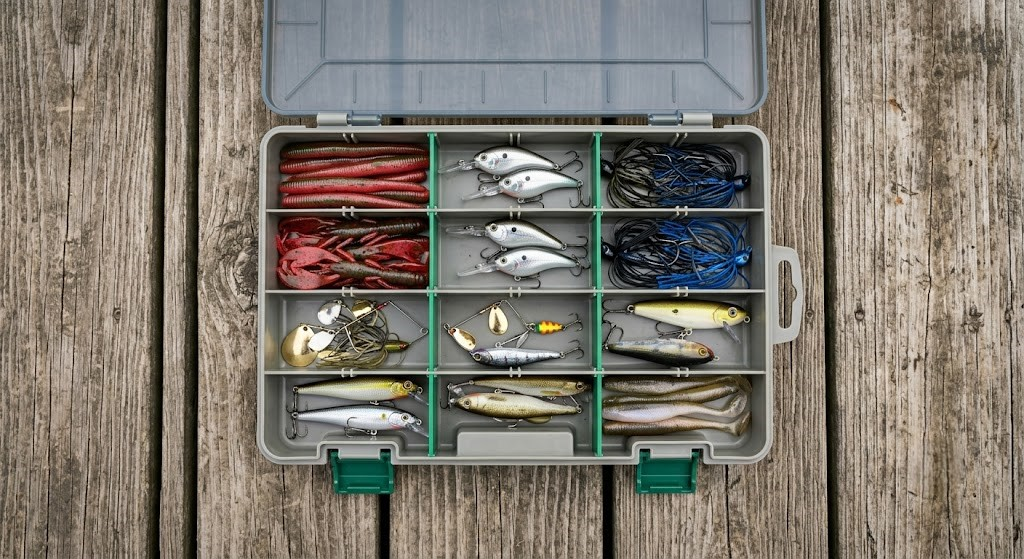
Crankbaits with slender, long lips dive the deepest. This slender deep dive crankbait also produces a wider wobble than standard wobbles, and this exact wobble is what you need in cold water.
HELMTACKLE Recommendation:
Suspending Deep Diving Crankbaits Minnow Fishing Lure
Designed with a large lip for rapid deep diving and wider coverage.
Features vibrant, durable finishes and an internal steel ball system for stable swimming action and enticing rattling sound.
Built tough with reinforced treble hooks for maximum penetration.
Color Selection Based on Water Clarity
The golden rule for color selection is to match the water clarity and the local primary forage (Match the Hatch).
- Water Clarity Match: Use natural colors in clear water, and bright/fluorescent colors in muddy water.
- Forage Match: If bass are feeding on shad, white or chrome crankbait lures might be highly effective.
If bass are feeding on bluegill, dark color patterns with orange or yellow accents might work well.
To learn more about color selection, please read: What Color Fishing Lure is Best? The Ultimate Lure Color Guide
Silent vs. Rattling Crankbaits: When to Use Which

- Rattling Crankbaits:
A rattling crank bait contains loose lead weights, beads, or a specially designed chamber inside. As the bait swims, it clearly emits sounds even in muddy water, broken surfaces, or heavy cover situations.
Rattling crankbaits often trigger strikes by being noticed by the fish. They are very suitable for muddy waters, expansive open waters, or when water temperatures are high and baitfish are active.
HELMTACKLE Recommendation:
Mini Crankbait Square Bill Ultralight Lures for Catfish
Professional-grade 3D fish-eye design for lifelike appeal.
Equipped with razor-sharp treble hooks, high-strength split rings, and export-grade paint finish.
The square bill design makes it an ideal ultralight choice (1/10oz) for navigating complex shallow water environments.
- Silent Crankbaits:
Silent crankbaits do not have rattling beads inside. They only rely on the lip to churn the water, the body to wobble, and the hooks rubbing against the body surface to produce a clicking sound.
Silent crankbaits often work once they enter the fish’s visual or lateral line perception range. I highly recommend using them in clear water, after a cold front passes, or in shallow areas.
HELMTACKLE Recommendation:
Deep Diving Crankbait Rattling Minnow Lure for Freshwater
Stunning 3D holographic design and hyper-realistic detailing.
Features an internal rolling ball system that creates enticing sound waves and optimizes weight for longer casts.
Outfitted with high-carbon steel hooks to resist rust and ensure exceptional sharpness.
Essential Fishing Gear for Deep Diving Crankbaits
Selecting the Right Casting Rod
Casting heavy deep-diving lures and retrieving them for long periods places high demands on the fishing rod.
It is recommended to choose a fiberglass or composite casting rod with a certain degree of flexibility to cushion the bites on heavy deep-water lures.
Also, a medium action or fast action fishing rod with a length of 7’-7’6”. It allows the rod to bend lower and farther, thereby preventing the treble hooks from tearing out of the fish’s mouth.
HELMTACKLE Recommendation:
Ultralight Fishing Rod – BFS Casting Rods Spinning Rods
Constructed with a 30+40T multi-angle cross-weave high-modulus carbon blank for the perfect balance of strength and sensitivity.
Features precision low-friction guides for smooth, long casts, and a natural wood-insert reel seat with a high-grade cork handle to amplify every subtle strike.
Why You Need a Low Gear Ratio Baitcaster Reel
The massive lip of a deep diving crankbait creates extreme drag in the water.
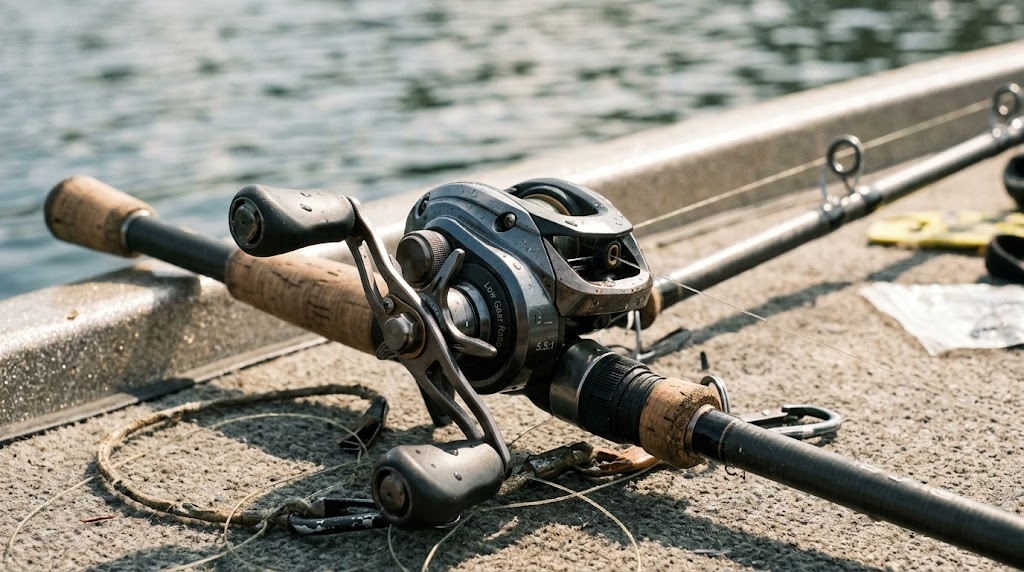
A low gear ratio (e.g., 5.4:1, 6.2:1) baitcaster reel can provide anglers with greater cranking power, which can significantly reduce the hand fatigue caused by deep water resistance.
Choose a fishing reel with a deep spool, large line capacity, and a lower gear ratio.
HELMTACKLE Recommendation:
Round Reel-Bait Finesse System Reel
A true BFS reel disguised in a classic round chassis, capable of casting micro-lures down to 1/16 oz (1.5g).
Features precision-machined solid brass main gear, an ultra-lightweight aluminum spool, and an audible drag clicker (fish alarm) to enhance the thrill of the fight.
Fluorocarbon vs. Braided Fishing Line for Max Depth
For deep water crankbaits, fluorocarbon fishing line is absolutely the gold standard.
- Fluorocarbon Line:
Fluorocarbon is denser than water and sinks naturally, which can help your crankbait dive an extra 1-2 feet.
It has moderate stretch (more elastic than braided fishing line, less than monofilament), providing both excellent bottom-feeling signals and shock absorption. It is recommended to use 10lb – 12lb thin-diameter fluorocarbon line; the thinner the diameter, the less water resistance, and the deeper it dives.
- Braided Line:
Although braid is extremely thin and has zero stretch, it floats, which will pull your lure upward and prevent it from reaching its maximum diving depth.
Unless you are fishing in extremely deep, heavy grass areas and pairing it with an ultra-long fluorocarbon leader, it is not recommended to use braided fishing line as the main line for deep diving crankbaits.
Step-by-Step: How to Fish a Deep Diving Crankbait
Locating Deep Water Structure
A deep diving crankbait deflecting off rocks will trigger a fish’s reaction strike. Therefore, in open water, you can use sonar or experience to look for underwater drop-offs, points, and rock piles.
According to Wired2Fish‘s advice, casting your fishing lure parallel to deep water currents or structure edges can usually locate the most concentrated schools of fish.
The Long Cast Strategy
Long-distance casting is the core of making a deep diving crankbait work. The diving trajectory of a crankbait is a “U-shaped” curve.
The farther you cast, the longer the time and distance the lure has to dive to its maximum depth (the Strike Zone), and the longer it stays in the bottom structure.
Paired with a long fishing rod, casting with the wind, and thinner fluorocarbon line, cast the bait to the absolute limit of your casting distance.
Bottom Bouncing and Deflection
This is the soul of the crankbait: “Bottom Deflection.”
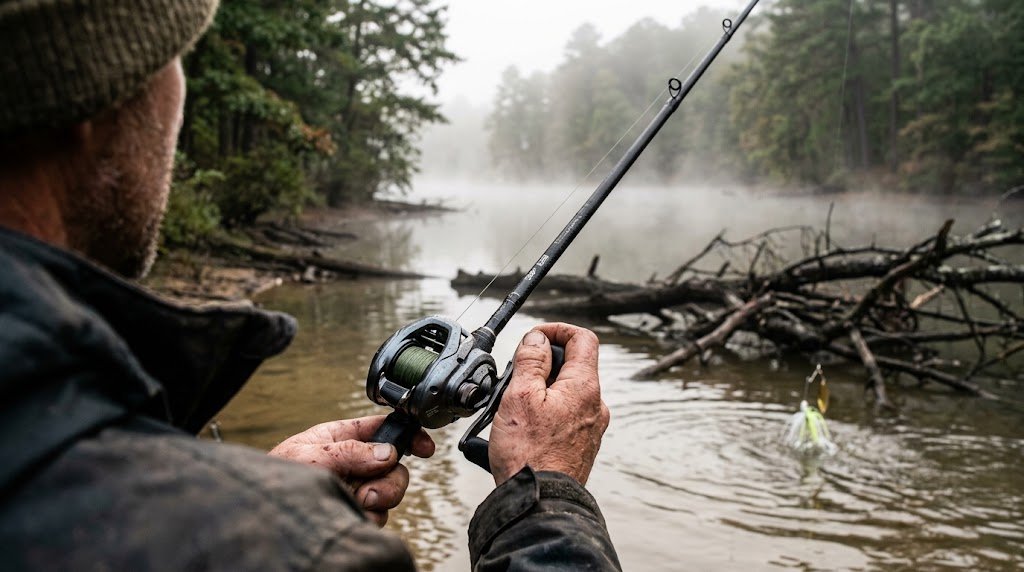
Never just retrieve through empty water columns. You must let the lip of the lure constantly dig into the mud/sand bottom, or bump into underwater rocks and deadwood.
The moment the lure hits an obstacle and suddenly deflects to the side, losing its balance, it creates a massive disturbance signal, which often triggers an irresistible reaction strike from nearby bass.
To learn more about bottom fishing, please read: How to Avoid Snags When Bottom Fishing?
The Stop-and-Go Retrieve
After casting an extremely long distance, retrieve quickly for a few turns. Let the deep diving crankbait sink to 10 feet (about 3 meters) or deeper as quickly as possible. Then retrieve at a steady pace.
Key technique: If it hits an underwater obstacle, you can stop your retrieve for 1-2 seconds.
Since the vast majority of deep-diving lures suspend or float up slowly, this pause not only allows the lure to float backward to bypass obstacles and avoid snagging, but also increases the hook-up rate.
To learn more about retrieval techniques, please read: The Best Retrieval Methods for Different Lures

Common Mistakes When Using Deep Diver Crankbaits
Retrieving Too Fast
Retrieving too fast causes the diving posture to collapse and prevents deep diving.
Many beginners will reel as fast as they do with topwater lures.
Retrieving too fast will cause the deep diving crankbait to lose its original balanced posture (blow out) or even roll over and surface, failing to dive into deep water structures at all.
Staying patient and feeling the rhythmic wobble of the fishing lure is the key.
To learn how to use crankbaits, please read: How To Fish A Crankbait For Bass?
Using Line with Too Much Diameter
Using line that is too thick creates excessive water resistance, which is a fatal mistake that severely affects the diving depth.
Due to the high resistance in deep water, some anglers will use thick lines of 17lb or even 20lb.
Excessively thick line diameter creates huge buoyancy and water resistance, which may cause a lure rated for a 20-foot dive to only reach 14 feet, perfectly missing the location of the fish school below.
Stick to using high-quality 10-12lb fluorocarbon line to pursue the ultimate depth.
Ignoring the “Feel” of the Bottom
Ignoring the bottom feedback brings the risk of snagging or getting skunked.
If you can’t feel the dynamic movement of the lure, you are essentially fishing blind.
Ignoring the bottom feedback signals not only makes you miss the best time to “pause” and tease the fish, but also significantly increases the risk of snagging, breaking the line, and losing the lure.
Learn to use your wrist to sense whether the lure is swimming in open water (regular vibration), digging in the mud (dull dragging feel), or hitting rocks (crisp bumping feel).
Final
Ready to upgrade your deep-water arsenal? Explore HELMTACKLE’s premium collection of [Crankbaits & Jerkbaits] today, featuring aerodynamic designs and ultra-durable elongated lips specifically designed for monster bass in deep structures. Let’s cast deep and catch big!
FAQ
How fast should I reel a crankbait?
You should use a slow to medium, steady retrieve to keep the fishing lure at its maximum diving depth while maintaining a natural wobble.
What is the best color for deep diving crankbaits?
Choose natural, translucent shad patterns in clear waters, and switch to bright, high-contrast colors like chartreuse or firetiger in muddy waters.