Blog
Are Spinnerbaits Good for Winter?


Table of Contents
Yes, spinnerbaits are highly effective for winter bass fishing.
When water temperatures drop between 40°F and 52°F, a heavy, slow-rolled spinnerbait perfectly mimics dying baitfish, triggering the attack desire of lethargic bass that are uninterested in fast-moving fishing lures.
Why Spinnerbaits for Bass Work in Cold Water
Spinnerbaits excel in winter because they provide a stable swimming action while remaining snag-free in heavy cover.
Triggering Reaction Strikes from Lethargic Winter Bass
When the weather turns cold and water temps drop to 40°F–52°F, bass activity decreases and metabolism slows down. Many novice anglers might abandon spinner baits.
On the contrary, the flash, vibration, and ability to cover different depths make them the best lures for cold water fishing.
According to largemouth bass biology, cold-blooded predators stop chasing erratic prey to conserve energy.
When using a spinnerbait with a slow retrieve, the flash, movement, and vibration they produce are just right to mimic struggling baitfish, attracting bass that refuse to attack fast, aggressive baits in cold conditions.
Prime Winter Conditions: Muddy Water, Warming Trends, and Deep Cover
Winter bass often inhabit deep water structures, rocky bluffs, and steep drop-offs, where they can conserve energy and wait for easy prey.
According to Mississippi State University’s seasonal water stratification research, the following three conditions have a high probability of success: post-winter rain stained/muddy water, shallow water warming trends on sunny afternoons, and deep standing timber or rocky transitions.
Spinnerbait vs Chatterbait in Winter: Which Blade Wins in Cold Water?
A vibrating jig (chatterbait) is suitable for high-frequency vibrations along grass edges. It can be used near wood, but its open hook makes it easier to get tangled in woody cover.
A blade spinnerbait performs much better around woody cover. Its wire arm and blades practically act as a weed guard, protecting the hook and preventing snags.

Choosing the Best Spinnerbait Blades, Weights, and Colors for Winter
Colorado Blade Spinnerbait vs. Double Willow Spinnerbait
Blade geometry determines vibration, flash, and lift. Colorado blades work best in cold water.
As stated in the Bassmaster cold water spinnerbait field guide:
- COLORADO
Colorado blade spinnerbaits feature wide, round, deeply cupped blades.
Speed: Slower, due to its large surface area.
Action: Produces a strong low-frequency thump even at low speeds because it displaces a large amount of water.
Best application: Cold water, as this type is usually paired with a slow retrieve. Or muddy water, relying on strong vibration to attract fish.
- WILLOW
Willow blade spinnerbaits feature narrow, long blades with a slight cup.
Speed: Due to the narrow profile, it cuts through water quickly, focusing on high-speed flash.
Action: High-speed movement generates massive flash, visible to fish even from a distance.
Best application: Most situations where fish are active and chasing bait, mimicking schools of freezing, dying shad, making it suitable for most conditions.
Downsizing to Compact Spinnerbaits vs. Heavy 1/2 oz – 3/4 oz Profiles
For pressured fish in shallow water, use 1/4 oz or 3/8 oz compact spinnerbaits for bass to reduce your profile and lower the guard of fish in clear shallows.
In deep water (10–20 feet), selecting a 1/2 oz or 3/4 oz spinnerbait allows it to reach the deeper areas where cold-water bass live, providing a steady retrieve without rising too fast in the water column.

Proven Winter Skirt Patterns: White, Chartreuse, and Black & Blue
Natural, muted colors like white, silver, and shad patterns mimic local forage, making bass more likely to believe your spinner bait lure is an easy target.
In clear water, choose all white (All White / Silver Shad). In slightly stained water, choose a chartreuse/white combo (Chartreuse/White). For extremely muddy or dark deep water, a high-contrast black and blue combo (Black & Blue spinnerbait) is a must.
How to Rig a Spinnerbait with Trailers for Cold-Water Short Strikes
Winter bass frequently nip at the skirt but won’t inhale it. Choosing the right trailer and hook combination can convert these short strikes into actual catches.
Best Spinnerbait Trailers for Slow-Rolling (Paddle Tails vs. Split-Tail Minnows)
- Shallow water slow-rolling: A ribbed paddle tail paired with a spinnerbait adds a small booting tail that slows the sink rate and increases the body roll. It produces just the right swimming action in clear water without looking overly exaggerated.
- Deep water fast sinking: A spinnerbait paired with a slender split-tail / fluke soft plastic reduces water resistance. Used in deep water, it allows the fishing lure to sink quickly to the bottom edge.
Adding a Spinnerbait Trailer Hook Without Fouling in Deep Cover
When fishing open rocky banks or main lake points, adding a free-swinging trailer hook (secured with a rubber stopper) can increase your winter hookup rate by 40%.
When fishing in dense standing timber or underwater brush, you should immediately remove the trailer hook to keep it snag-free.
How to Fish a Spinnerbait in Winter: Retrieve Techniques & Rod Setup
Fishing with a spinnerbait in winter requires heavy tackle and strict depth control.

Mastering the Bottom-Hugging “Slow Roll”
The ultimate winter technique is Slow-Rolling.
- Cast and sink: Cast the bait past the area where bass might hold, and wait for the lure to sink completely to the bottom after casting.
- Slow retrieve: Then, retrieve it steadily at the absolute minimum speed that barely allows the blade to turn, keeping it just above the cover.
- Kill the hook: Pause slightly every few turns to mimic a dying baitfish falling.
A slow retrieve keeps the lure in the bass’s strike zone longer, giving the bass plenty of time to approach. Please read our complete guide on how to use a spinnerbait to catch more bass.
Best Spinnerbait Rod, Low-Gear Baitcaster, and Line Setup for Cold Water
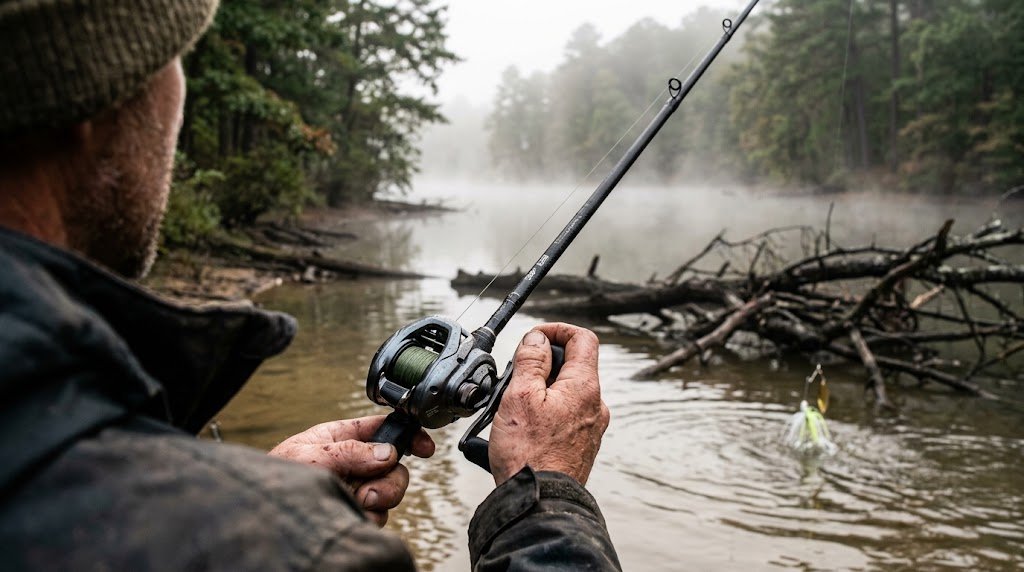
- Rod: A 7’0″ Medium-Heavy (MH) casting rod with a moderate-fast tip. You need enough backbone to drive the hook home firmly in deep water, but the tip must be flexible enough so sluggish bass don’t rip the bait free.
- Reel: Use a low-gear ratio baitcasting reel (5.4:1 – 6.3:1) from your freshwater reels. A high-speed reel will cause the angler to retrieve too fast, pulling the fishing lure out of the winter bass’s strike zone.
- Line and knot: 12 lb to 15 lb fluorocarbon line. This line sinks fast and can sensitively detect light bites. Never use a snap swivel; tie the line directly to the wire loop to maintain blade vibration.
Final
Explore our tournament-grade Jigs & Spinnerbaits collection and gear up for your next cold-water fishing trip today!
FAQ
What lures work best in winter?
The best winter fishing lures are those that can be worked extremely slowly along the deep bottom, such as heavy spinnerbaits (requiring a bottom-hugging slow retrieve), jigs, and suspending jerkbaits.
What time of year to use spinnerbaits?
A spinnerbait is a versatile, all-season fishing lure: spring and fall are great for medium-to-fast, large-area searching, while winter (water temps down to 42°F) is perfect for bottom-hugging, extremely slow retrieves paired with heavy weights.