Blog
How to Use a Spinnerbait to Catch More Bass?

Table of Contents
If you want to catch aggressive bass in challenging environments, almost no other lure can match the versatility and powerful fish-attracting ability of a spinnerbait for bass. Whether you are navigating heavy cover, dealing with muddy water, or facing overcast and windy weather, knowing how to fish a spinnerbait can quickly turn a tough day on the water into your new personal best.
In this ultimate guide, we will break down all the crucial information for you, from choosing the right spinnerbait blades and skirt colors to mastering the spinnerbait retrieve techniques that trigger explosive reaction strikes.
What is a Spinnerbait and When Should You Throw It?
The Anatomy of a Spinnerbait: Blades, Skirts, and Hooks
A spinnerbait fishing lure is a wire bait consisting of an L-shaped or R-shaped metal frame, a silicone skirt, blades, and a jig head hook, with the blades being the core component of this bass fishing lure.
The blades mimic baitfish through their flashing light, producing vibrations that can be detected by a fish’s lateral line.
The spinnerbait skirts help provide bulk and lifelike pulsating action for the spinnerbait’s wide-area search.
The lead head is the weighted portion, determining the running depth of the bait.
The hook is a single hook with excellent weedless performance, making it perfectly designed for a powerful hookset.
To learn more techniques for preventing bottom snagging, please read: How to Avoid Snags When Bottom Fishing?
Best Weather and Water Conditions for Spinnerbait Fishing
When to use spinnerbait? Spinnerbaits work best when there is a disturbance in the environment, such as on cloudy days, windy days, and in muddy water conditions.
Furthermore, according to fisheries biology insights from Bassmaster, bass rely heavily on their lateral line to hunt in stained or muddy water.
In muddy water, bass use their lateral line to detect water vibrations around them to hunt, and the spinning blades of a spinnerbait push water to create a distinct vibration trail.
Both bass and baitfish have excellent vision. Bass are sensitive and feel safer in areas with lower visibility, so on sunny days, they tend to hold in deeper water.
Low-light weather conditions make it difficult for prey to see far, creating the perfect hunting moment for predators. My spinner baits for bass fishing can realistically mimic baitfish, and when clouds block the sun, their vibration truly outshines the lack of flash.
How to Choose the Right Spinnerbait for Different Conditions
Fishing Blades: Willow, Colorado, and Indiana
- Colorado Blade: Maximum Thump for Muddy Water
Colorado blades are rounded and cupped. They produce heavy vibrations and a thumping sound, but with less flash.
Colorado blade spinnerbait has an absolute advantage in muddy water and night fishing, scenarios where fish typically rely on vibration to feed.
- Willow Blade: High Speed and Flash in Clear Water
Willow blades are long and slender like willow leafs; they offer maximum flash and minimal water resistance as they cut through the water, though they produce very little vibration.
The Willow blade spinnerbait is ideal for clear water or when a fast retrieve is needed.
- Indiana Blade: The Versatile Middle Ground
Indiana blades are shaped like a teardrop, offering a hybrid of Colorado and Willow blades that balances both flash and vibration.
When you are exploring a new lake and aren’t sure what the bass want, Indiana blade spinnerbait is your ultimate scout bait.
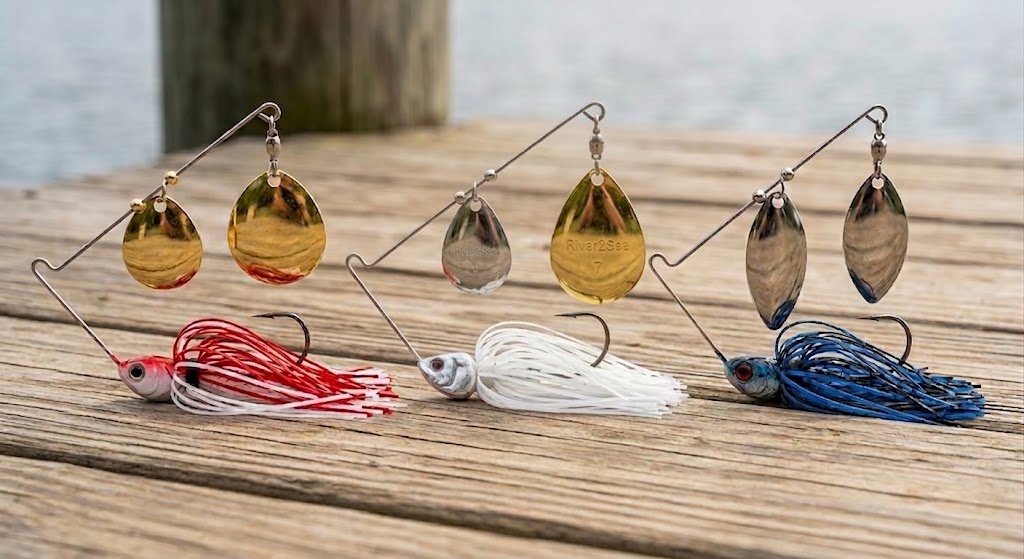
Matching Skirt Colors to Water Clarity
You don’t need to buy every color on the market; you just need to use the right color in the right water. Use natural or translucent colors for clear water, and high-contrast colors for muddy water. As visibility decreases, silhouette and contrast become more important than an exact color match.
- Clear water: Clear, silver, or white spinnerbait bass lure. This naturally mimics the subtle flash of baitfish.
- Stained water: Chartreuse, gold, or white spinnerbait. This ensures they can be seen by the fish without being too overpowering.
- Muddy water: Solid black, dark blue, or bright orange spinner baits paired with painted or copper blades, helping fish locate them via a hard silhouette.
For more lure color guide, please read: What Color Fishing Lure is Best?
Selecting the Perfect Weight for Your Target Depth
Choosing the perfect weight is crucial for keeping your lure right in the strike zone.
- 3/8 oz: The standard setup for shallow water (1 to 3 feet). It allows for a moderate retrieve over submerged grass beds without sinking too fast.
- 1/2 oz: The most versatile size. Perfect for mid-depth ranges (3 to 5 feet) and casting around docks and laydowns.
- 3/4 oz to 1 oz: Essential choices for deep water (10+ feet), where you need the bait to stay close to the bottom during a slow roll retrieve.
How to Fish a Spinnerbait: Retrieve Techniques to Trigger Strikes
The Slow Roll (Ideal for Deep or Cold Water)
Your spinnerbait for bass retrieve speed should always adapt to the water temperature.
In deep water, when water temperatures are low—bass are sluggish, so employ a slow retrieve.
Cast out your spinnerbait and let it sink completely to the bottom. Slowly turn the fishing reel—just fast enough to keep the blades spinning.
Keep an eye on your spinnerbait rod tip; as long as it is slightly pulsing, your blades are working. This keeps the lure directly in the face of inactive bass.
Bumping Cover and The Stop-and-Go Method
One of the most effective ways to trigger a reaction strike is by intentionally colliding your spinnerbait with underwater structure.
Cast past a stump, laydown, or rock pile, and reel the bait directly into it. When the lure deflects off the wood or rock, it causes the spinnerbait blades to flutter and change direction momentarily.
This sudden, erratic movement perfectly mimics a panicked baitfish, triggering vicious strikes from ambush predators.
Waking the Surface in Shallow Water
Over weed beds or in the shallows—fast retrieve: During this time, bass are typically on spawning beds or feeding very aggressively.
Keep your casting rod tip high and reel fast, making the blades bulge the water’s surface without actually breaking through.
Using this high-speed retrieve gives the fish almost no time to inspect the bait, forcing them to make a split-second decision to attack. I have found this method especially effective when fishing for smallmouth bass.
Pro Tips for Landing More Fish with Spinnerbaits
When to Add Spinnerbait Trailers: Hook or Soft Plastic Trailer
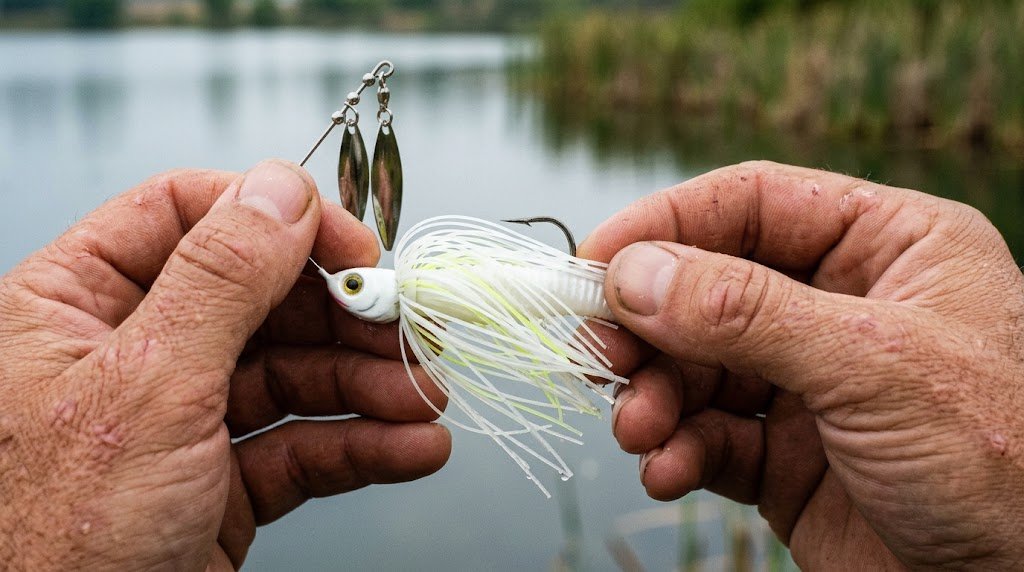
A spinnerbait’s performance can be significantly enhanced by adding soft plastic trailers or a trailer hook.
Soft plastic trailers: Such as a curly tail grub, which can increase the profile and add a secondary swimming action. I frequently use them in cold water or muddy water conditions.
Trailer hook: You can add one in almost any situation, except in heavy vegetation or when using a short-arm spinnerbait. But remember that the hook point must face the same upward direction as the main spinnerbait hook, otherwise it will snag on weeds.
Avoiding Common Hookset Mistakes
The most common mistake beginners make is setting the hook the instant they feel a bump.
Often, that initial bump is just the bass hitting the blades, or the spinnerbait deflecting off a branch.
Do not snap-set immediately; instead, wait until you actually feel the weight of the fish load up on your casting rod.
Once you feel that heavy, solid pull, execute a firm, sweeping hookset to drive the heavy-gauge hook firmly into the fish’s mouth.
Conclusion
By matching your blade types and skirt colors to the water conditions, utilizing deflection techniques, and relying on a powerful casting rod setup, you will be well-prepared to trigger strikes even on the toughest days. Tie on a spinnerbait, target that heavy structure, and hold on tight—the next strike could be your new personal best!
FAQ
How to tie a spinnerbait?
Tie your line directly to the wire bend using a Palomar knot or Improved Clinch knot. Do not use snap swivels.
What are spinnerbait lures good for?
They are weedless reaction lures, perfect for catching bass in heavy cover, muddy water, and windy conditions.