Blog
Best Bass Fishing Lures for Summer


Table of Contents
Midsummer is not a “tough fishing” season—it’s a season that requires upgrading your approach. When water temperatures enter the 22°C–30°C (72°F–86°F) range, the behavior patterns of largemouth and smallmouth bass shift significantly:
Active feeding windows shrink (concentrated at dawn and dusk)
During the day, fish move to deeper water or heavy cover (Cover & Structure)
They rely more on “reaction bites” rather than active feeding
This means: it’s not that there are no fish—you’re simply not placing your lure in the “effective strike zone.”
This guide systematically breaks down: the 7 lure categories that truly work in summer, precise matching strategies for different times/water columns/weather conditions, and practical parameters.
Factors Affect Summer Bass Fishing Lure
Bass are cold-blooded, meaning their metabolism is directly tied to water temperature. In summer, especially during July and August, their feeding behavior becomes highly specific. From a biological and behavioral standpoint, an effective summer lure must satisfy four core mechanisms:
Trigger Reaction Strikes
In high temperatures, bass are less willing to chase but will strike at sudden stimuli.
Cover Penetration
In summer, 80% of fish hold in: grass / laydowns / docks
Forage Matching
Primary summer forage: bluegill / shad / crawfish
Enhanced Detection (Low Visibility Conditions)
Requires: vibration / rattle / flash
Top 7 Best Bass Fishing Lures for Summer
Big Worm (Texas-Rigged or Carolina-Rigged)
When the sun is high and bass are tight to structure, nothing beats a soft plastic worm for bass. Its slow, subtle action is highly effective.
Best for: midday feeding, bushes, and deeper holding areas.
Length: 10-inch+ ribbon tail or straight tail worms.
Color: green pumpkin in clear water; junebug / black blue in stained water.
Pro tip: let it soak. Sometimes bites come after 10 seconds of dead-sticking.
Jigs
Jigs remain one of the most versatile and effective summer lures. They imitate crawfish and bluegill—two dominant forage types.
Best for: dock skipping, ledges, and rocky structures.
Weight: 3/8 to 1/2 oz football jigs or flipping jigs.
Color: Black/blue, green pumpkin, or brown.
Pro tip: Flip into shaded dock areas and let it fall naturally—most strikes occur on the fall.
Drop Shot Rig
Best for: high-pressure waters / clear water / visible fish
In hot conditions, when bass become less aggressive, the drop shot becomes a key finesse technique. It keeps the bait in the strike zone longer and presents naturally.
Best baits: worms, flat worms, or small finesse plastics.
Setup: light line (6–8 lb fluorocarbon) and spinning gear.
Targets: brush piles, ledges, or suspended fish。
Pro tip: Watch your sonar—this is the best method for catching bass you can see but can’t trigger with power baits.。
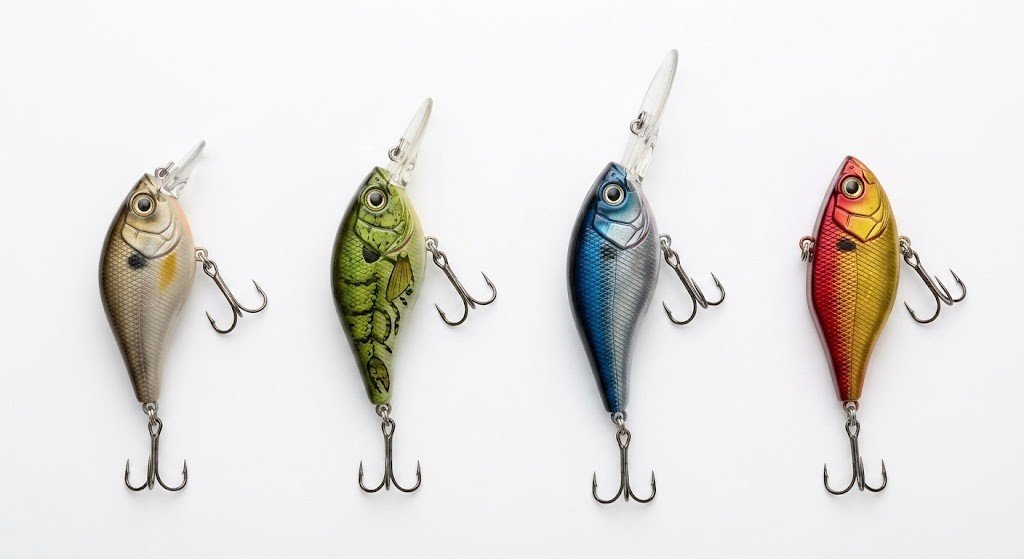
Deep Diving Crankbait
In summer, bass often hold at 15–25 ft. Deep-diving crankbaits reach these zones, trigger reaction bites, and allow fast water coverage. Use sonar to locate hard bottoms or bait schools. For more tips, please read “How to Fish A Crankbait for Bass.”
Best for: ledges, humps, and deep water.
Target depth: 4.5m–8m (15–25 ft).
Pro tip: change angles—multiple casts from different directions can trigger inactive fish.
Flutter Spoon
When bass suspend under shad in deep water, flutter spoons excel. The flash and falling action mimic dying baitfish—highly attractive to big bass.
Best for: vertical presentation over deep schools.
Size: 4–6 inch chrome or white spoons.
Pro tip: don’t overwork it—the slow fall is what gets bites.
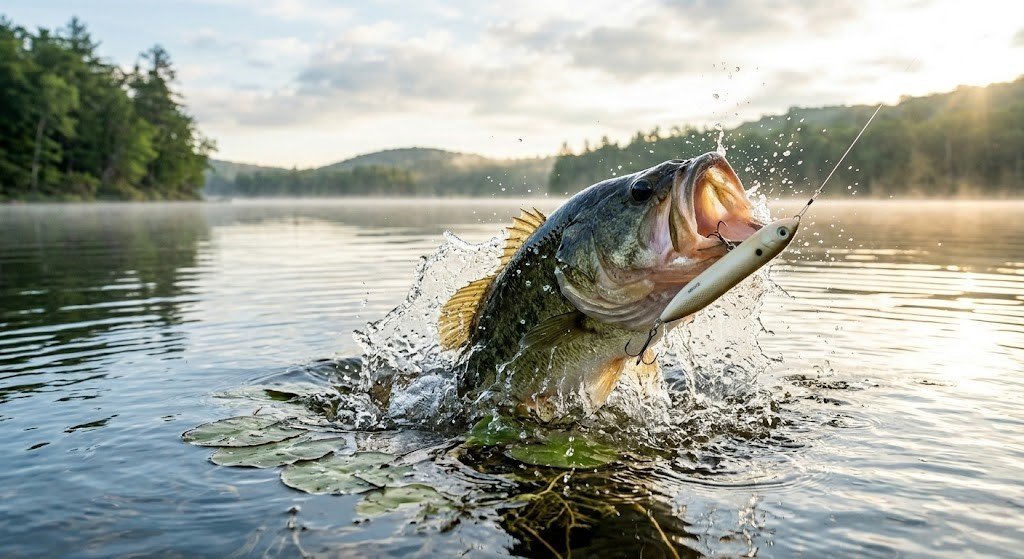
Topwater Spook (Walking Bait)
When bass are feeding on shad at the surface, a walking bait lets you cover water quickly with a “walk-the-dog” action.
Best time: early morning, cloudy days, or schooling activity.
Best colors: bone, chrome, or translucent.
Setup: medium-heavy rod with 30–50 lb braided line.
Pro tip: wait until you feel weight before setting the hook—summer topwater strikes can be explosive but often miss the bait.
Creature Baits
Creature baits have bulky profiles with subtle action, imitating crawfish and bluegill.
Best for: punching grass, flipping cover, or dragging through bushes.
Rigging: texas rig or jig trailer.
Applications: heavy vegetation, flooded timber, or grass flats.
Color: watermelon red, black/blue, green pumpkin.
Pro tip: if bites are slow, trim the bait or add rattles.
When to Use Each Type of Lure
| Time of Day | Best Lures |
| Early Morning | Frogs, buzzbaits, chatterbaits |
| Midday | Worms, jigs, drop shots |
| Late Evening | Topwater, spinnerbaits |
| Cloudy/Windy | Crankbaits, bladed jig |
Pro Tips
- Follow the shade
In strong sunlight, bass position around docks, wood, or overhanging trees.
- Reduce pressure
In heavily fished lakes, finesse techniques are more effective.
- Adjust speed
Reaction baits work in the morning; switch to finesse in the afternoon.
- Use scent
In warm water, scent can enhance effectiveness, especially on soft plastics.
Conclusion
Most “no fish” situations are not caused by gear, but by failing to match the combination of summer structure + depth + timing.
A mature summer strategy looks like this:
Morning: topwater to locate active fish
Midday: worms/jigs to target structure
Deep: crankbaits/spoons to scan schools
The core is not choosing the “best lure,” but building a lure system.
FAQ
What is the most consistent summer bass lure?
Jig + worm combination, covering 80% of scenarios.
Why is midday fishing harder in summer?
Fish move to deeper water or heavy cover, requiring slow presentations and precise targeting.
Should you use bigger lures in summer?
Yes. Larger profiles are more effective at triggering reaction strikes.