Blog
What Time Should I Go Saltwater Fishing?

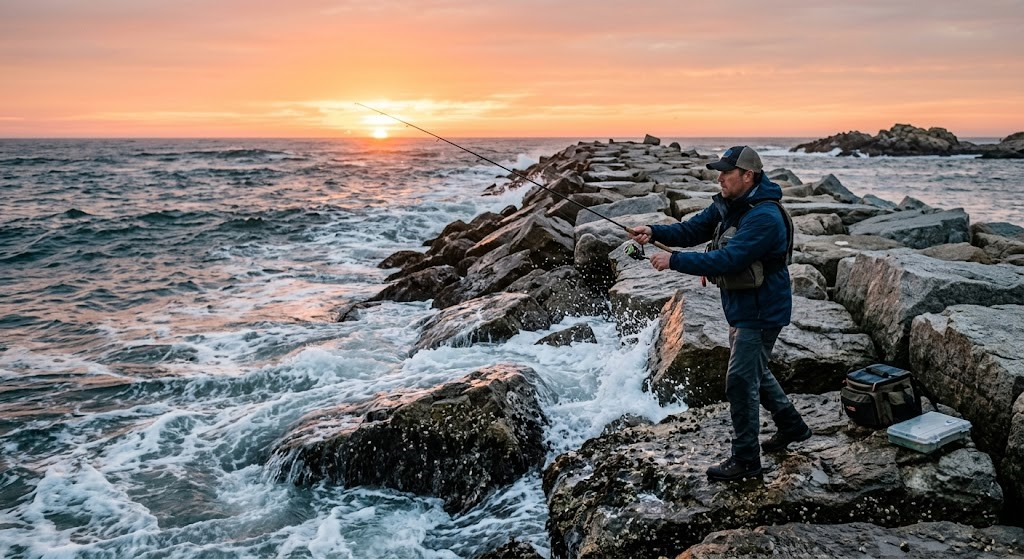
Table of Contents
Successful saltwater fishing requires not only patience but also precise timing. Whether you are an experienced veteran or a beginner just starting out, everyone often asks the same question: “When is the absolute best time to go saltwater fishing?” The answer is not a single point in time, but rather a perfect combination of tides, time of day, weather, and professional gear.
This guide will help you crack the “time code” of saltwater fishing, ensuring you return fully loaded on your next trip.
Understanding Tides: The Secret to Saltwater Fishing Success
For saltwater fishing, tides are the core element determining fish activity. Generally, the hour before and after high or low tide is the golden fishing window. According to the scientific explanation by the National Oceanic and Atmospheric Administration (NOAA Tides and Currents), the changes in water levels and currents brought by tides are the key engines driving the marine ecological food chain.
The Best Tide to Fish: Moving Water is Key
The best tide for fishing is a moving tide. Abundant water flow means that baitfish and crustaceans will also be actively swimming, which in turn causes predatory fish to feed aggressively.
Look for areas where the tide pushes the current through hard structures (such as rocks, breakwaters, reefs, bridge pilings, oyster reefs, coastal headlands, or seagrass beds). Any place that creates a current intersection or obstruction often holds big fish—this is a practical tip I learned on Reddit!
High Tide vs. Low Tide: Where to Position Yourself
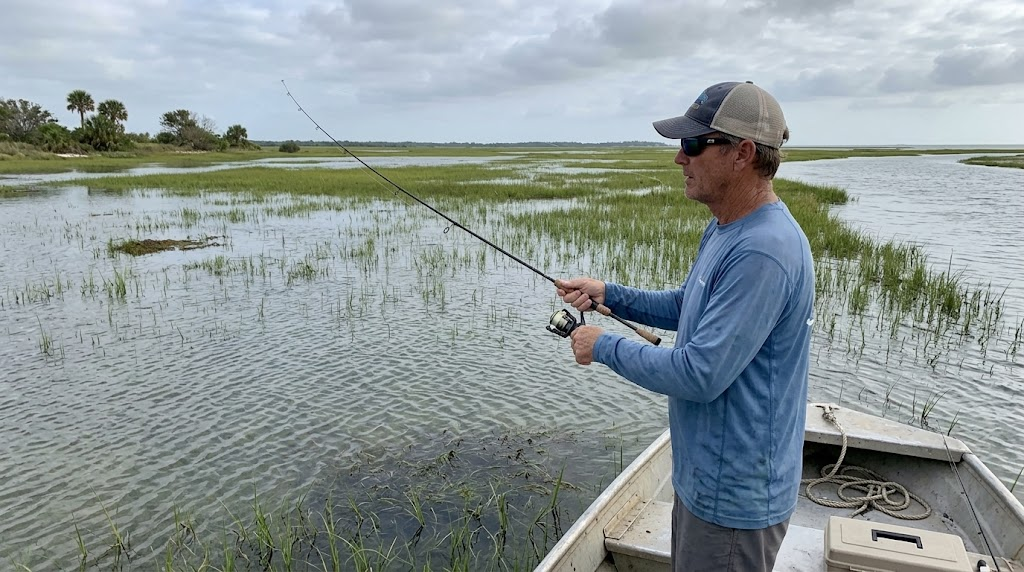
High tide is considered one of the best fishing times. The water flowing from the ocean into the estuary is usually cooler, has higher oxygen content, and is clearer than the water in the estuary during low tide or slack water, which prompts fish to feed actively. I usually cast my line in shallow bays and inland flats, ambushing the schools of fish that swim onto the flats with the incoming tide.
During low tide, the current usually carries small fish and crustaceans into streams, river mouths, and deep channels, and large fish will often wait at the estuary. I usually fish in nearshore areas around dock pilings or other underwater structures. At this time, switching to a fishing lure jerkbait that can dive quickly to search the middle and lower water columns is an excellent choice.
If you start fishing on an incoming tide, around halfway between low and high tide, catching fish shouldn’t be a problem. But if you choose to fish during an outgoing tide, especially starting at dead low tide, your chances of landing a good catch will significantly decrease.
Slack Tide: Why You Might Want to Take a Break
Slack tide refers to the brief period when the tidal current stops, with no rise or fall. Fishing during a slack tide is extremely difficult because the slow water movement leads to decreased bait activity, and consequently, the fish won’t feed aggressively. Therefore, I usually take a break during this time.
Best Time of Day for Saltwater Fishing: Morning, Evening, or Night?
The Magic of the Early Morning Bite (Dawn)
Saltwater fish are usually most active at dawn. As the sun just begins to rise, the soft, dim morning light makes the fish feel less threatened. After a night, the water temperature is cooler (with the highest dissolved oxygen levels), the water surface is generally calmer, and there are fewer boats. Fish tend to be more active, emerging from their nighttime hiding spots to forage.
You can use topwater lures in the morning, such as topwater popper, which makes a splashing sound that makes it much easier to attract explosive surface strikes from fish in calm water.
Evening and Dusk: The Second Golden Window
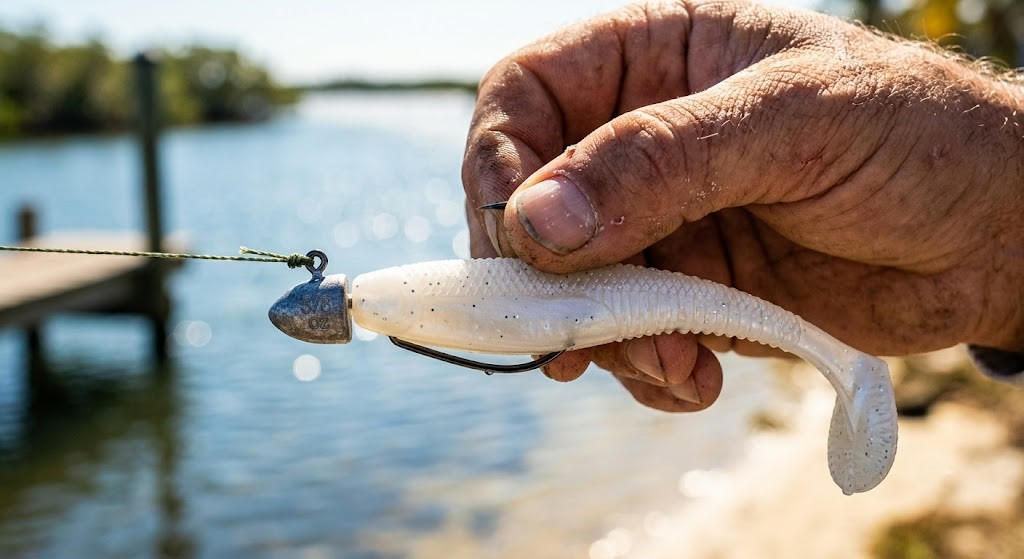
As the light fades in the evening and the water temperature begins to drop, it reactivates the fish that were hiding from the daytime heat, bringing them out to feed because they feel safer in the dim light. Fish like sea bass, tarpon, and redfish are especially known for their evening feeding habits. During this period, I usually fish in shallow water, using soft plastic lures that mimic baitfish for finesse fishing, which is highly effective!
Night Fishing: Targeting Nocturnal Saltwater Monsters
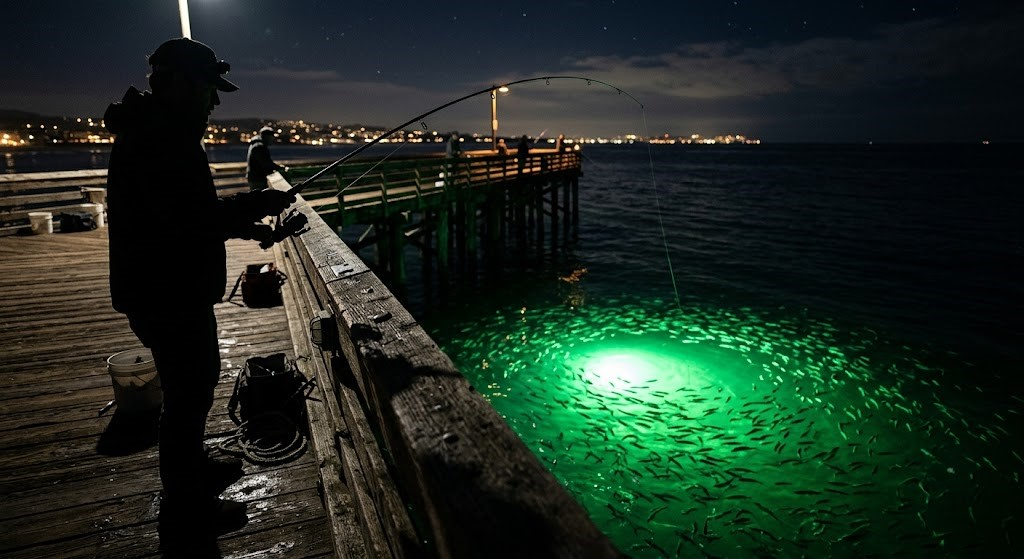
Night fishing is most beneficial for species like sea bass and striped bass. Both of these fish become much more active after nightfall. Piers, inlets, bridges, and channels are the spots you want to look for when night fishing.
Artificial lights attract large amounts of plankton and baitfish, which in turn draw in the big fish. If you want to know more about night fishing, please read: How to Bass Fish at Night?
Weather and Moon Phases: Hidden Factors You Can’t Ignore
How Overcast Skies Extend the Bite Time
Don’t cancel your fishing plans just because of a cloudy day. Cloud cover blocks the harsh sunlight and reduces the penetration of light into the water, which essentially extends the “dim light effect” of dawn and dusk.
Under overcast conditions, fish will maintain a higher level of activity even at noon. Additionally, barometric pressure drops before a storm or front will also trigger the fishes’ frantic feeding instincts.
Fishing the Full Moon and New Moon Tides
During a full moon or new moon, the alignment of the sun, earth, and moon creates spring tides due to gravitational superposition. This extreme tidal range brings unusually strong currents, forcing baitfish to move frantically, thereby triggering aggressive bites.
Furthermore, the ample nighttime illumination during a full moon makes visual foraging much easier and more active for nocturnal fish.
Essential Inshore Saltwater Gear for Any Time of Day
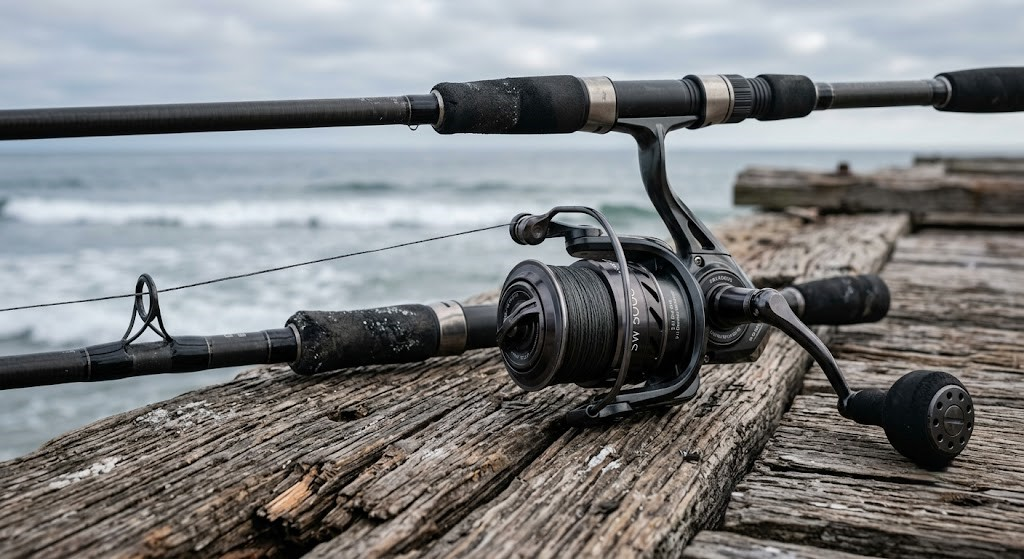
Even if you have mastered the time and tides, without a handy set of gear, you still won’t be able to turn opportunities into catches. For inshore fishing, a spinning combo is the perfect choice for tackling various golden fishing times, thanks to its long-casting performance, anti-backlash stability, and extreme versatility.
Saltwater Inshore Spinning Rod Specifications
Length: 7’0″, 7’6″, 8’0″, 9’0″
Power: Medium (M) to Medium Heavy (MH)
Action: Fast or Moderate-Fast Action
Lure Weight Rating:1/2 oz – 2 oz (Depending on target species)
Line Weight Rating: 10 lbs – 30 lbs (Braid preferred)
Saltwater Spinning Reel Specifications
Size: 3000, 4000, 5000 (Based on rod length and target fish)
Gear Ratio: 5.2:1 to 6.2:1
Max Drag Power: 15.0 lbs – 25.0 lbs
Drag System: Sealed Carbon Fiber Drag System
Ball Bearings: Shielded or Sealed Stainless Steel Bearings
Reel Weight: 9.0 oz – 14.0 oz
Conclusion
The best time to go saltwater fishing is not a fixed schedule, but rather a convergence of tidal currents, lighting conditions (dawn/dusk), and suitable weather. When planning your next trip, check the tide chart first, lock your fishing time within the “moving water” periods of the incoming or outgoing tide, try to avoid the blazing midday sun, and bring your trusty spinning combo. Now, grab your gear and get ready for the next explosive bite!
FAQ
Is it better to fish the incoming or outgoing tide?
Both are excellent as long as the water is moving. Incoming tides bring clean water to shallow flats, while outgoing tides push baitfish into deeper channels where predators wait.
Does rain affect saltwater fishing?
Yes. Light rain breaks the surface tension and hides your presence, while the dropping barometric pressure before a storm often triggers aggressive feeding.